
How much Yarsagumba should you take?
Dosage guidance for wild Cordyceps Sinensis (Yarsagumba) varies significantly depending on whether you follow traditional Tibetan and Chinese medicine protocols, modern clinical research, or the pragmatic norms of contemporary users. This guide covers all three — and compares how dosage translates across raw, powder, tincture, and capsule formats.
Traditional Tibetan and Chinese dosing
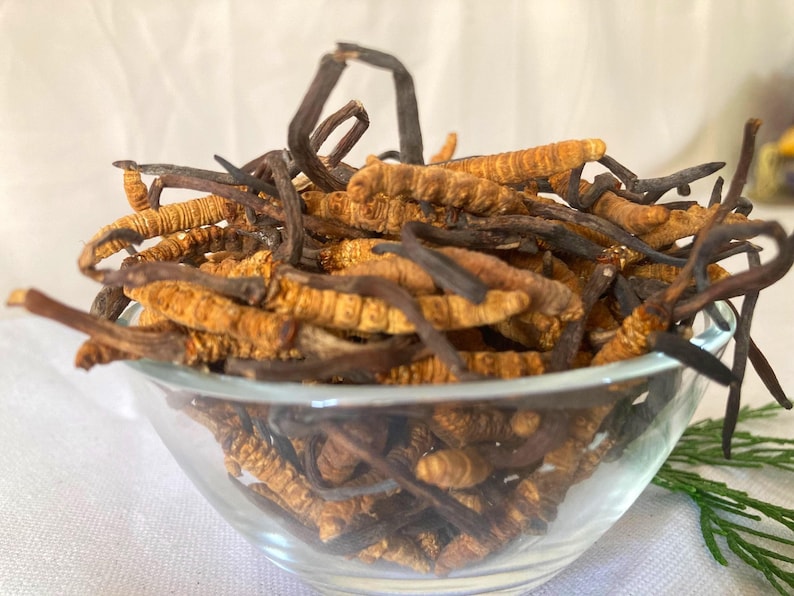
Traditional Tibetan medicine prescribed Yarsagumba in whole-piece form, prepared in soups, broths, or steeped in hot water. The standard prescription in classical Tibetan pharmacopoeia texts (Gyushi, the "Four Tantras") is 1–3 pieces per day, taken with soup, stewed meats, or broth. One whole piece of quality Yarsagumba typically weighs 0.4–0.7g — placing the traditional daily dose at roughly 0.5–2g of whole dried material.
Chinese pharmacopoeia (Bencao Gangmu Shiyi and later editions) gives a broader range: 3–9g per day of whole dried Cordyceps Sinensis for therapeutic use, typically in decoction (simmered broth). This higher range reflects the use of mixed-grade or lower-potency material, and the decoction format which extracts polysaccharides efficiently.
Both traditions emphasise consistency over intensity: Yarsagumba was prescribed as a daily tonic over months and years, not as a single large dose. The cumulative, tonic application — particularly through winter — is the context for almost all traditional therapeutic claims.
Modern clinical research dosages
There is no established medical dose. The few human trials used different products and amounts, usually cultivated extracts rather than whole wild pieces, so their doses don't translate directly:
- Exercise study (Chen et al., 2010)1g daily1 g a day of Cs-4, a cultivated cordyceps extract, for 12 weeks in 20 adults aged 50–75. Not wild Yarsagumba.
- Kidney trials (Cochrane review, 2014)VariedChinese trials of cordyceps preparations given alongside standard treatment. Doses varied, and the reviewers rated the evidence low quality.
Important caveat: most clinical research was conducted with standardised CS-4 extracts or CS polysaccharide fractions — not with whole wild Yarsagumba. Bioavailability and potency differ between whole wild material and isolated extracts, so exact dose equivalence cannot be stated with certainty. See our full research library for specific citations.
Practical Yarsagumba dosage by format
How you take Yarsagumba determines how the dose is measured and how bioavailability behaves. Below are practical guidelines for each format available from Yarsa-Gumba.
Raw whole Yarsagumba
Whole-piece preparation retains the full bioactive spectrum. Polysaccharides extract well with long simmers (30–60 min). Cordycepin is heat-stable and extracts in both hot water and alcohol. For a first month, start with 1 piece every other day and observe.
Tea preparation guideCordyceps capsules
Our capsules contain 500mg of pure milled wild Cordyceps Sinensis with no fillers. One capsule aligns with the lower end of traditional dosing; two capsules approach the clinical research range. Take with food to reduce the rare case of stomach sensitivity.
See Cordyceps capsulesCordyceps tincture
At a 1:5 extract ratio, 1ml of tincture represents approximately 200mg of dried CS equivalent — concentrated. The dual-extraction method (water + alcohol) captures both the polysaccharide and the cordycepin fractions that single-solvent extracts miss. Best taken sublingually for faster onset.
See liquid tincturePerformance powder
Stone-milled to 80 microns for full dissolution. 1g per serving aligns with clinical research doses. Athletes who use Yarsagumba specifically for training often take it 30–60 minutes before exercise; tonic users take it consistently each morning regardless of training.
See performance powderHow long before you notice effects?
Yarsagumba is a tonic, not a pharmaceutical. Traditional use is measured in seasons, not days. Most users report:
- Days 1–14
No perceptible change in most users. The initial period of polysaccharide and cordycepin accumulation.
- Weeks 3–6
Athletes often notice improved breathing economy and reduced perceived effort at moderate intensity first.
- Weeks 6–12
Sleep quality, energy on waking, and recovery speed are the most commonly reported improvements from non-athlete users.
- 3–6 months
Cumulative tonic effects — the traditional application — become most apparent at this range of consistent daily use.
If you experience no change after three months of consistent daily use at appropriate doses, consider whether your baseline health context (sleep, stress, diet) leaves room for the specific mechanisms CS acts on. Yarsagumba is most effective for people with genuine deficiency states — fatigue, low stamina, extended recovery times — rather than as an enhancement for people already in peak condition.
Buy wild Yarsagumba direct from Nepal.
Raw whole pieces, capsules, tincture, and powder — all made from A+ grade wild-harvested Cordyceps Sinensis from the Nepali Himalayas.