
Cordyceps Sinensis benefits: what the evidence actually shows.
Short answer: Cordyceps Sinensis (Yarsagumba) has a long history as a traditional tonic, but the human evidence for specific health benefits is still thin. Most studies are in the lab or on animals, many use cultivated mycelium rather than wild Yarsagumba, and the human trials are small. Below is what has actually been tested in each area people ask about. This is not medical advice, and we don't claim Yarsagumba treats any disease.
Exercise and oxygen use
This is the area people ask about most. Cordycepin and adenosine are involved in how cells make energy (ATP), and that is the basis for the interest in endurance.
The best-known human trial is Chen et al. (2010): 20 healthy adults aged 50–75 took Cs-4, a cultivated cordyceps mycelium, or a placebo for 12 weeks. The cordyceps group showed a modest improvement in metabolic and ventilatory thresholds. It was small, used a cultivated strain rather than wild Yarsagumba, and other trials in trained athletes have found no clear effect.
You will also read that Chinese runners broke world records in 1993 thanks to cordyceps. Their coach said so at the time, but the records were widely questioned and later reports alleged systematic doping on that team. It is a story, not evidence.
Chen S. et al. (2010). Effect of Cs-4 (Cordyceps sinensis) on exercise performance in healthy older subjects: a double-blind, placebo-controlled trial. J Altern Complement Med 16(5):585–590.
Immune activity
Cordyceps contains polysaccharides (β-glucans) that have changed the activity of immune cells such as macrophages and natural killer cells in laboratory and animal studies.
That is a long way from showing that eating Yarsagumba strengthens a person's immune system. Good-quality human trials are lacking, so we don't make that claim. In traditional practice it was taken through winter and after illness as a general tonic.
Laboratory and animal studies; no large human trials. See our research library for individual papers.
Kidney function
In Chinese medicine Yarsagumba was traditionally linked to the kidneys, and kidney disease is the area with the most human trials, almost all from China and often using cordyceps preparations alongside standard treatment.
A 2014 Cochrane review pooled 22 of these trials. It found some possible benefit on kidney function markers but rated the evidence as low quality, and said better trials are needed before any recommendation can be made. If you have kidney disease, Yarsagumba is not a substitute for your treatment; speak to your doctor.
Zhang H.W. et al. (2014). Cordyceps sinensis (a traditional Chinese medicine) for treating chronic kidney disease. Cochrane Database of Systematic Reviews, CD008353.
Antioxidant activity
Extracts of cordyceps show antioxidant activity in the test tube and in animal studies, and wild Yarsagumba is naturally high in mannitol and nucleosides.
Antioxidant activity in a lab does not mean slower ageing in people. There are no human studies showing that cordyceps extends life or reverses ageing, and we don't claim it does.
Laboratory and animal studies only.
Traditional use as a vitality tonic
Tibetan medical texts describe Yarsagumba as a tonic for strength and vitality, and in Nepal and Tibet it has long been given to older men in particular. That tradition is where the tabloid nickname comes from.
Some animal studies have measured changes in hormone levels, but there is no reliable human evidence that it works as a sexual enhancer. We sell it as a traditional food and tonic, not as a treatment for any sexual or fertility problem.
Traditional use; animal studies only.
Blood sugar
A polysaccharide from cultivated Cordyceps sinensis mycelium lowered blood sugar in diabetic mice in a 1996 study, and later animal work has looked at blood fats.
There is no good human evidence for blood-sugar control. If you have diabetes, don't use cordyceps in place of your medicine, and tell your doctor before you take it, because it may add to the effect of blood-sugar-lowering drugs.
Kiho T. et al. (1996). Hypoglycemic activity of a polysaccharide (CS-F30) from the cultural mycelium of Cordyceps sinensis. Biol Pharm Bull 19(2):294–296.
A note on wild vs. lab-grown Cordyceps
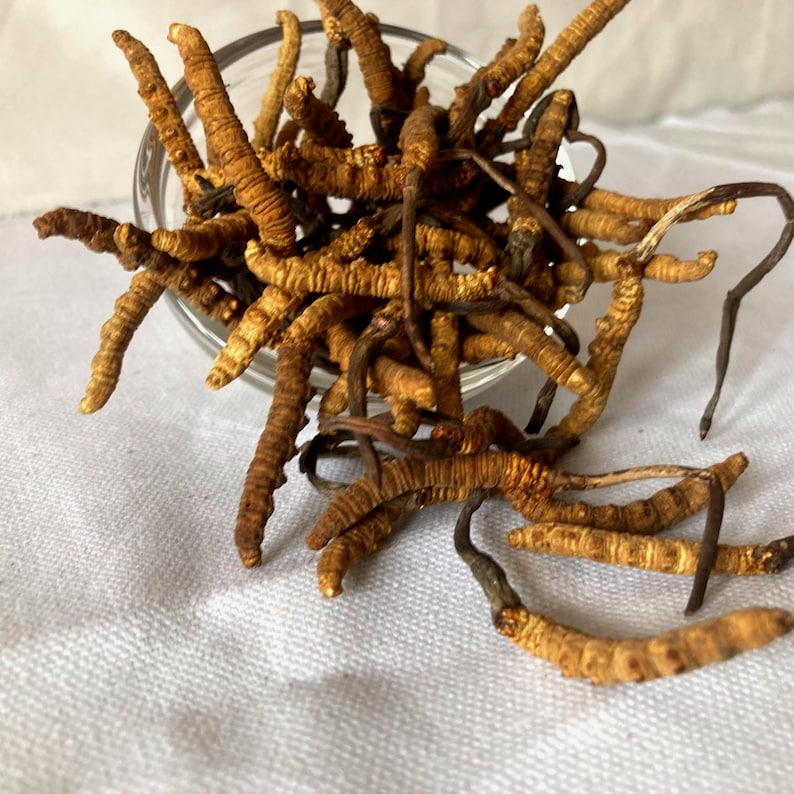
Much of the research labelled "Cordyceps sinensis" was actually done with cultivated mycelium such as Cs-4 (Paecilomyces hepiali) or with Cordyceps militaris, because wild material is scarce and expensive. Those results can't be assumed to apply to wild Ophiocordyceps sinensis, and the reverse is also true.
When reading supplement marketing, check what is actually in the product. A capsule of "cordyceps" powder at a few dollars a gram is cultivated mycelium or militaris, not wild Yarsagumba. Wild whole pieces trade at around $15 per gram at the Nepal harvest, so a retail price far below that is a warning sign.
See our full comparison of wild vs. lab-grown cordyceps and our complete research library with the individual studies.
Buy wild Cordyceps Sinensis direct from Nepal.
8 weights from 15g ($390) to 1kg ($24,000). A+ grade, hand-harvested, sun-dried. DHL Express worldwide from Kathmandu.